If there is one AML/CTF concept every accounting firm needs to master before 1 July 2026, it is Customer Due Diligence — known as CDD.
It is the foundation of the entire AML/CTF compliance regime, and it is the obligation that will consume the most staff time. This guide explains what customer due diligence for accounting firms involves, the different levels of due diligence, and how VERA transforms a manual chore into an automated workflow.
What Is Customer Due Diligence?
CDD is the process of identifying and verifying who your clients really are, understanding the nature and purpose of the business relationship, and assessing the money laundering and terrorism financing risk they present. Under AUSTRAC rules, CDD must generally be completed before you provide a designated service.
43% of AML compliance failures globally relate to inadequate customer due diligence and identity verification, according to analysis of regulatory enforcement actions cited in industry research.
The Three Levels of Due Diligence
1. Simplified Due Diligence (SDD)
Applied to low-risk clients — for example, listed public companies or government entities. Fewer verification steps are required, but the client must genuinely meet the low-risk criteria.
2. Standard Customer Due Diligence
The default level for most clients. It involves collecting and verifying identity information — full name, date of birth, residential address — using reliable and independent documentation or electronic verification.
3. Enhanced Due Diligence (EDD)
Applied to higher-risk clients — including politically exposed persons (PEPs), clients in high-risk jurisdictions, or complex ownership structures. EDD requires additional information, senior approval, and closer ongoing scrutiny.
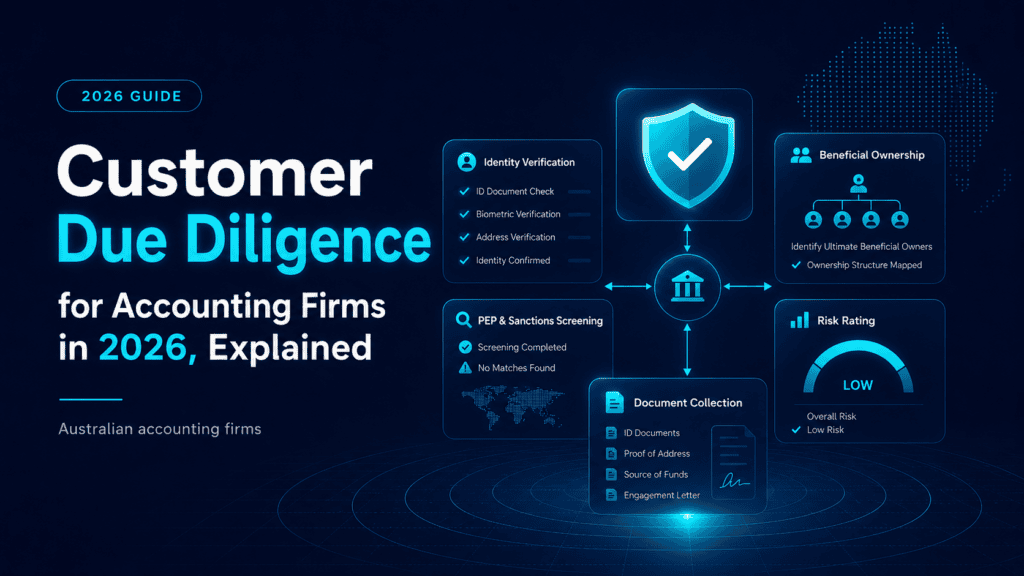
What CDD Actually Requires You to Collect
- Identity verification: full name, date of birth, and residential address, verified against reliable documents.
- Beneficial ownership: for companies and trusts, identifying the individuals who ultimately own or control the entity (generally 25% or more).
- Nature and purpose: understanding why the client needs your services and whether it makes commercial sense.
- PEP and sanctions screening: checking the client against politically exposed persons lists and sanctions watch lists.
- Risk rating: assigning each client a money laundering / terrorism financing risk score.
Beneficial Ownership: The Tricky Part
One of the hardest parts of CDD is identifying beneficial owners — the real humans behind a company or trust. Criminals deliberately use layered structures to obscure ownership.
The Financial Action Task Force has repeatedly identified opaque beneficial ownership as one of the top global money laundering vulnerabilities. Accounting firms, who often set up these very structures for clients, are uniquely placed to identify them — and uniquely obligated to.
Why Manual CDD Does Not Scale
“A single standard CDD check can require document collection, manual verification, watch-list screening across multiple databases, and documentation — 15 to 30 minutes of skilled staff time, every time.”
For a growing firm, manual customer due diligence becomes a bottleneck. It delays client onboarding, frustrates clients who expect fast service, and ties up senior staff in repetitive admin.
How VERA Automates the Entire CDD Workflow
🤖 Meet VERA — Client Verification Automation
Built specifically to automate customer due diligence for accounting firms. VERA:
- Performs automated VOI (Verification of Identity) checks against reliable data sources
- Screens clients against PEP, sanctions, and adverse media watch lists
- Applies consistent, rules-based risk scoring to every client
- Flags higher-risk clients for enhanced due diligence and human review
- Generates complete, audit-ready CDD records automatically
The result: client onboarding that used to take 30 minutes now happens in minutes, with greater consistency and a complete audit trail. VERA does not replace professional judgment — it removes the manual grind so your team can focus on the decisions that genuinely require human expertise.
Try VERA Free — No Card Needed
Sign up and get 50 free credits to run live CDD checks and see how VERA handles VOI, screening and risk scoring for your firm.
Start Free – Get 50 Credits →Not Sure How to Get Your Team AML/CTF Ready?
Start with the essentials: your AML/CTF policy, client verification process, and staff training plan. Complete this quick intake form and we’ll prepare a draft AML/CTF policy tailored to your firm — including your firm’s details, services, responsible persons, and client onboarding workflow.
Get AML Policies & Staff Training in 15 Mins →Key Takeaways
- CDD is the core AML/CTF obligation and must be completed before providing services.
- There are three levels: simplified, standard, and enhanced due diligence.
- Beneficial ownership identification is the hardest and most scrutinised element.
- VERA automates VOI, screening, risk scoring, and record-keeping end to end.
Discover How NeX Automate Simplifies AML/CTF Compliance
See how VERA turns a 30-minute manual CDD chore into an automated, audit-ready workflow — in a quick, no-pressure call.
Book a Free Discovery Call →New to the reforms? Start with our plain-English guide to what AML/CTF means for Australian accounting firms, or compare the best AML/CTF compliance software for accounting firms to find the right fit for your practice.