Written by the NeX Automate Compliance Team
Reviewed for accuracy against current AUSTRAC guidance and public enforcement records. NeX Automate builds AML/CTF and client-verification automation used by Australian accounting practices. This guide is general information, not legal advice — confirm your firm’s specific obligations with AUSTRAC or a qualified adviser.
Last updated: July 2026
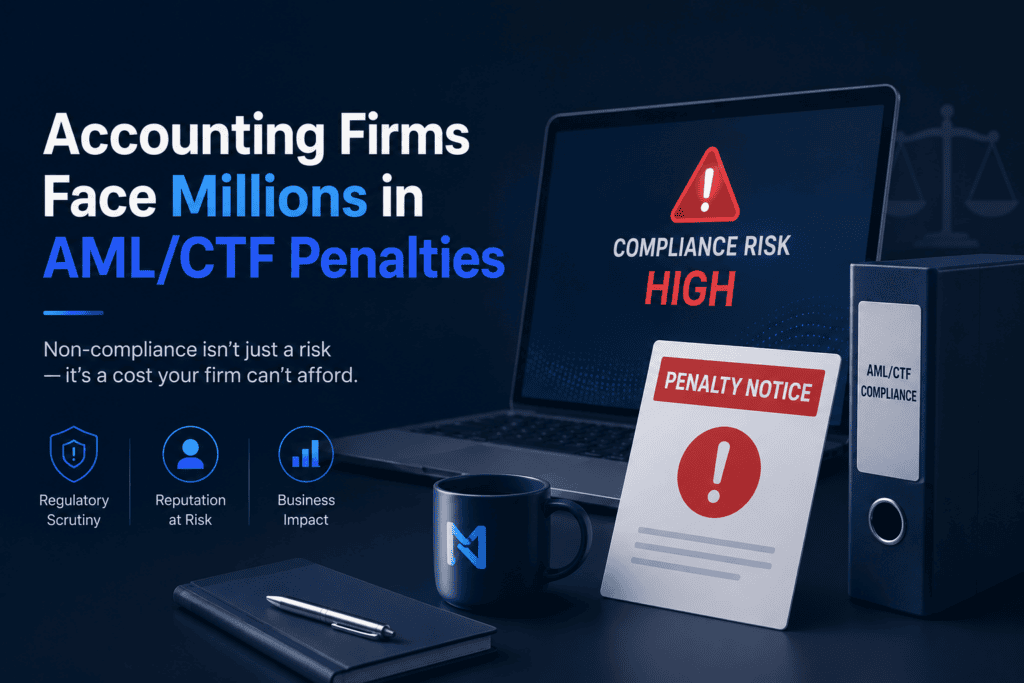
AML/CTF compliance is sometimes treated as a box-ticking exercise. The enforcement record tells a very different story. Australian regulators have imposed some of the largest corporate penalties in the country’s history for AML/CTF failures.
With accounting firms inside the regime since 1 July 2026, understanding AML/CTF penalties and enforcement is no longer optional. Firms now need to know what non-compliance can cost, where enforcement risk usually comes from, and how VERA helps reduce that risk through consistent client verification automation.
The Penalties That Made Headlines
AML/CTF penalties in Australia are not theoretical. AUSTRAC has pursued landmark cases resulting in record-breaking penalties, including a $1.3 billion penalty against a major Australian bank in 2018 and a $700 million penalty against another in 2020. These remain among the largest civil penalties in Australian corporate history.
For accounting firms, the message is clear: AML/CTF penalties and enforcement can create serious financial, operational, and reputational consequences.
The Penalty Framework
Under the AML/CTF Act 2006, breaches can attract civil penalties calculated in penalty units. For body corporates, individual contraventions can run into the millions of dollars. Because breaches may be counted per transaction, per client, or per compliance failure, totals can escalate quickly.
AUSTRAC’s enforcement toolkit includes:
- Civil penalty orders — court-imposed financial penalties for serious contraventions.
- Infringement notices — financial penalties for less serious breaches.
- Enforceable undertakings — binding commitments to fix compliance failures and improve systems.
- Remedial directions — orders requiring a firm to correct specific compliance deficiencies.
AML/CTF penalties and enforcement should not be viewed as a distant risk. It’s a practical compliance issue that needs clear systems, documentation, and accountability.
The Penalties Accounting Firms Should Worry About Most
For accounting firms, the most likely enforcement scenarios are not billion-dollar bank cases. The greater risk comes from everyday compliance failures that are easy to commit at scale:
- Failing to register with AUSTRAC
- Failing to conduct adequate customer due diligence
- Failing to lodge suspicious matter reports on time
- Inadequate record keeping
- Operating without a compliant AML/CTF program
- Applying client risk scoring inconsistently
- Missing identity verification steps during onboarding
This is where enforcement risk becomes closely connected to daily operations. If your firm relies on manual processes, staff memory, email threads, spreadsheets, or disconnected folders, it becomes much harder to prove that every client was verified, risk-rated, and documented properly. That is why AML/CTF compliance software and client verification automation are becoming important for accounting firms.
The Cost Beyond Penalties
“The financial penalty is often the smallest part of the cost. Reputational damage, lost clients, and remediation costs frequently exceed the fine itself.”
For a professional services firm built on trust, the reputational consequences of an AML/CTF breach can be severe. Clients may leave. Referral sources may withdraw. Professional indemnity premiums may rise. Staff may spend months fixing incomplete records, updating processes, and responding to regulator questions.
The cost of non-compliance extends far beyond the penalty AUSTRAC imposes. That’s why AML/CTF penalties and enforcement should be treated as a business risk, not just a legal risk — a weak compliance process can affect client confidence, internal workload, brand reputation, and long-term growth.
Why Manual Compliance Creates Enforcement Risk
Most AML/CTF failures don’t happen because firms deliberately ignore the rules. They happen because manual systems break under pressure:
- A busy staff member skips a verification step.
- A risk rating is applied differently by different team members.
- A document is saved in the wrong folder.
- A suspicious matter is noticed but not escalated in time.
- A client’s record is incomplete when the firm needs to prove compliance.
This is where accounting automation can help reduce operational risk. For firms already adopting workpaper automation, ATO Automation, ATO document automation, or ASIC Review Automation, AML/CTF workflows are the next logical area to systemise. Modern accounting automation for firms helps create repeatable processes, reduce manual gaps, and keep compliance tasks easier to track.
How VERA Reduces Your Enforcement Risk
Meet VERA — Client Verification Automation
The most common AML/CTF failures stem from inconsistency — verification skipped under time pressure, risk scoring applied unevenly, incomplete records, staff not following the same process every time. VERA eliminates these gaps by automating client verification to a consistent standard.
VERA performs VOI checks, watchlist screening, and risk scoring across every client, and retains complete, audit-ready records automatically. So when AUSTRAC asks how a client was verified, what risk rating was applied, and what records were retained, VERA provides the evidence behind the process.
At $4 per client verification, VERA is a fraction of the cost of a single compliance breach.
Reduce Your AML/CTF Risk — Protect Your Firm with VERA
Sign up and get 50 free credits to see how VERA builds the consistent, audit-ready trail that protects your firm if AUSTRAC ever comes knocking.
Start Free – Get 50 Credits →Why AI Automation Matters for AML/CTF Compliance
AML/CTF compliance is not a one-time registration task. It creates ongoing operational responsibility across onboarding, verification, risk scoring, suspicious matter detection, record keeping, and staff workflows. That is why AI automation for accounting firms is becoming essential — it reduces repetitive admin, improves accuracy, and keeps compliance workflows consistent across the firm.
For firms concerned about penalties and enforcement, automation can support:
- Consistent client verification
- More reliable risk scoring
- Clearer record keeping
- Reduced manual errors
- Better audit readiness
- Stronger internal accountability
- Faster compliance workflows
NeX Automate supports accounting firms with practical automation across AML/CTF compliance, client verification, documentation, and broader accounting operations.
See Where Your Firm Is Exposed
Book an AML readiness assessment and we’ll review your verification, risk scoring, record keeping, and escalation process — and pinpoint the gaps that create enforcement risk.
Book AML Readiness Assessment →Key Takeaways
- AML/CTF penalties in Australia have reached $1.3 billion for a single entity.
- Accounting firms may face penalties for registration failures, inadequate CDD, late reporting, weak record keeping, and non-compliant AML/CTF programs.
- Reputational damage often exceeds the financial penalty itself.
- Manual compliance processes increase the risk of inconsistent verification, missing records, and weak audit trails.
- VERA reduces risk by supporting consistent, automated, audit-ready client verification.
Protect Your Firm Before a Breach Costs You
VERA brings AML/CTF compliance, client verification, and AI automation into one consistent, audit-ready workflow — so your firm can prove compliance, not just claim it.
Start Free – Get 50 Credits →Sources & further reading
- AUSTRAC — Enforcement actions and outcomes
- AUSTRAC — Penalties and enforcement
- AUSTRAC — Tranche 2 entities and the 2026 reforms
- Financial Action Task Force (FATF) — The FATF Recommendations
Related guides: What AML/CTF means for accounting firms, Customer Due Diligence explained, Verification of Identity (VOI), Suspicious Matter Reports, and the best AML/CTF compliance software.