Written by the NeX Automate Compliance Team
Reviewed for accuracy against current AUSTRAC guidance. NeX Automate builds AML/CTF and client-verification automation used by Australian accounting practices. This guide is general information, not legal advice — confirm your firm’s specific obligations with AUSTRAC or a qualified adviser.
Last updated: July 2026
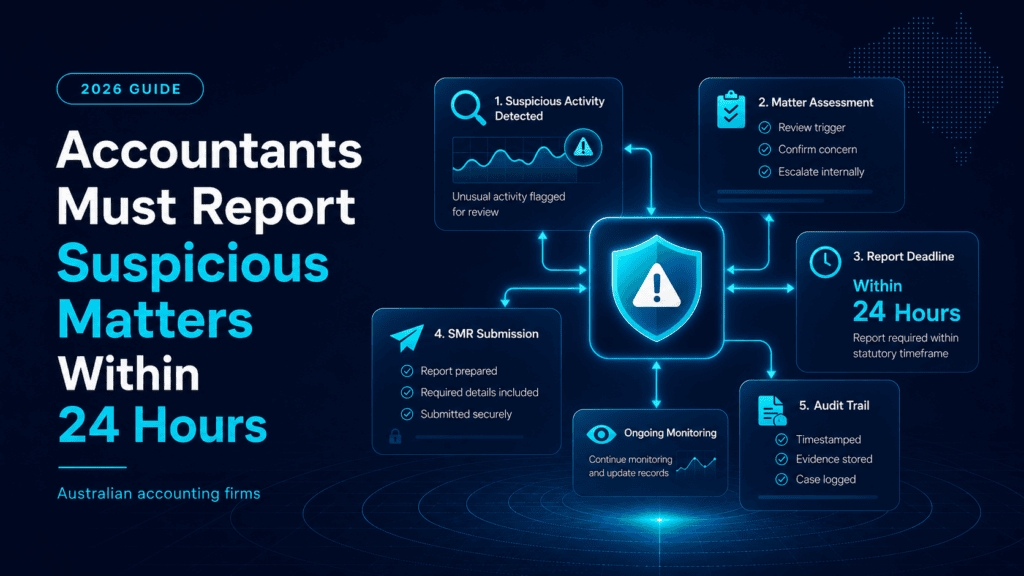
Of all the AML/CTF compliance obligations facing accounting firms, the Suspicious Matter Report — or SMR — is one of the most serious. It is the mechanism by which firms alert AUSTRAC to potential criminal activity, and it carries strict timing rules.
The reforms took effect on 1 July 2026, so this is now a live duty, not a future one. Every firm operating as a reporting entity is expected to detect, decide on, and lodge suspicious matters correctly — from the next client onward. This guide explains what triggers an SMR, when it must be lodged, and how strong client verification, powered by VERA, makes detection far easier.
What Is a Suspicious Matter Report?
A Suspicious Matter Report is lodged with AUSTRAC when a reporting entity forms a suspicion, on reasonable grounds, that a transaction or client may be linked to money laundering, terrorism financing, tax evasion, or other serious crime.
Importantly, you do not need proof. A reasonable suspicion is enough to trigger the obligation. That is why SMRs must be supported by strong client knowledge, proper documentation, and consistent internal workflows.
What Triggers an SMR?
An SMR may be triggered by several types of red flags during onboarding, client verification, or ongoing work. Common triggers include:
- Identity concerns — a client provides false, inconsistent, expired, or suspicious identity documents.
- Unusual structuring — transactions appear deliberately structured to avoid reporting thresholds or hide the real purpose of the activity.
- Inexplicable complexity — company, trust, or ownership structures have no clear commercial rationale.
- Source of funds concerns — the client’s wealth, funds, or transaction activity appears inconsistent with their known profile.
- Reluctance or evasiveness — a client avoids questions, refuses to explain a transaction, or becomes unwilling to provide supporting documents.
This is where client verification automation and AML/CTF compliance software can help firms detect risk indicators earlier and more consistently.
The Strict Reporting Timeframes
Under the AML/CTF Act 2006, SMRs carry firm deadlines. A report must generally be lodged:
24 hours — if the suspicion relates to terrorism financing.
3 business days — if the suspicion relates to money laundering or other serious offences.
Missing these deadlines can become a breach in itself. There is also a “tipping off” rule: your firm must not alert the client that an SMR has been, or may be, lodged.
For this reason, SMRs require more than awareness. Your team needs a clear process, an escalation pathway, and a documented decision-making workflow.
“You cannot report what you cannot see. The quality of your suspicious-matter detection depends entirely on the quality of your client knowledge.”
Why Detection Starts With Verification
Here is the connection many firms miss: you can only identify suspicious matters if you genuinely know your clients in the first place. Robust customer due diligence and identity verification create the baseline understanding against which unusual behaviour becomes visible.
A client whose identity was never properly verified, whose risk was never scored, and whose profile was never documented is a client whose suspicious behaviour may never be detected. That is why SMRs are closely connected to client onboarding, VOI, risk scoring, record keeping, and ongoing monitoring.
With accounting automation, firms can reduce manual gaps and build a more consistent detection foundation.
The Problem With Manual Detection
Manual suspicious matter detection is difficult because warning signs are often buried across emails, spreadsheets, document folders, staff notes, and disconnected systems. One staff member may notice an issue while another misses it. One client may be screened properly, while another moves through onboarding without complete checks. This inconsistency creates compliance risk.
For firms already using workpaper automation, ATO Automation, ATO document automation, or ASIC Review Automation, AML/CTF workflows are the next important area to systemise. Modern accounting automation for firms brings structure, consistency, and accountability to compliance processes that were previously handled manually.
How VERA Strengthens Suspicious Matter Detection
🤖 Meet VERA — Client Verification Automation
VERA, the Client Verification Automation from NeX Automate, helps build the foundation that makes SMR detection possible. By performing thorough, consistent VOI checks, screening clients against PEP and sanctions watchlists, and maintaining a clear risk profile for each client, VERA gives your firm the baseline client knowledge needed to identify when something doesn’t add up.
VERA can flag identity inconsistencies, watchlist matches, and high-risk indicators automatically — exactly the red flags that may warrant a closer look and, where appropriate, escalation for an SMR decision.
VERA does not make the suspicion judgment for your firm. It helps ensure warning signs aren’t missed in a pile of manual paperwork — making SMRs easier to manage, document, and review.
Build a Detection Foundation You Can Rely On
Sign up and get 50 free credits to see how VERA verifies clients, screens watchlists, and surfaces the red flags that matter — before they slip through the cracks.
Start Free – Get 50 Credits →Why AI Automation Matters for SMR Readiness
AML/CTF compliance is not a one-time registration task. It creates an ongoing operational responsibility that repeats with every new client and continues throughout the client relationship. That is why AI automation for accounting firms is becoming important — it reduces repetitive admin, improves accuracy, and keeps compliance workflows consistent across the firm.
For suspicious matter reporting, automation can support:
- Clearer client verification
- Stronger risk profiling
- PEP and sanctions screening
- More consistent red flag detection
- Better internal escalation
- Audit-ready documentation
NeX Automate supports accounting firms with practical automation across AML/CTF compliance, client verification, documentation, and operational workflows.
Not Sure Your Firm Could Spot an SMR Today?
Book an AML readiness assessment and we’ll walk through your current verification, screening, and escalation process — and show you where detection gaps could be putting your firm at risk.
Book AML Readiness Assessment →Key Takeaways
- An SMR must be lodged when there is reasonable suspicion of serious crime — no proof required.
- Terrorism financing suspicions generally require reporting within 24 hours.
- Money laundering or other serious crime suspicions generally require reporting within 3 business days.
- The “tipping off” rule prohibits alerting the client that an SMR has been or may be lodged.
- Detection starts with verification — you can’t report what you can’t see.
- AML/CTF is an ongoing operational load that repeats with every new client, so automation keeps detection consistent.
Strengthen Your AML/CTF Detection with NeX Automate
VERA supports stronger client verification, risk profiling, and red flag detection — bringing AML/CTF compliance, client verification, and AI automation into one consistent workflow.
Book a Free Demo →Sources & further reading
- AUSTRAC — Suspicious matter reports (SMRs)
- AUSTRAC — Tipping-off offence
- AUSTRAC — Tranche 2 entities and the 2026 reforms
- Financial Action Task Force (FATF) — The FATF Recommendations
Related guides: What AML/CTF means for accounting firms, Customer Due Diligence explained, Verification of Identity (VOI) explained, and the best AML/CTF compliance software.