Written by the NeX Automate Compliance Team
Reviewed for accuracy against current AUSTRAC guidance. NeX Automate builds AML/CTF and client-verification automation used by Australian accounting practices. This guide is general information, not legal advice — confirm your firm’s specific obligations with AUSTRAC or a qualified adviser.
Last updated: July 2026
At the heart of every AML/CTF compliance program is a deceptively simple question: is this client really who they say they are?
Answering it correctly is the job of Verification of Identity in AML/CTF — often called VOI. The reforms took effect on 1 July 2026, and AML/CTF obligations are now live for Australian accounting firms. If your practice is already compliant, VOI is now a repeatable day-to-day workflow. And if you’re among the firms still catching up, verification of identity is the fastest, highest-impact place to start.
This guide explains the VOI standard, why it matters for accounting firms now that the regime is in force, and how NeX Automate’s VERA supports faster, more consistent client verification.
What Is VOI?
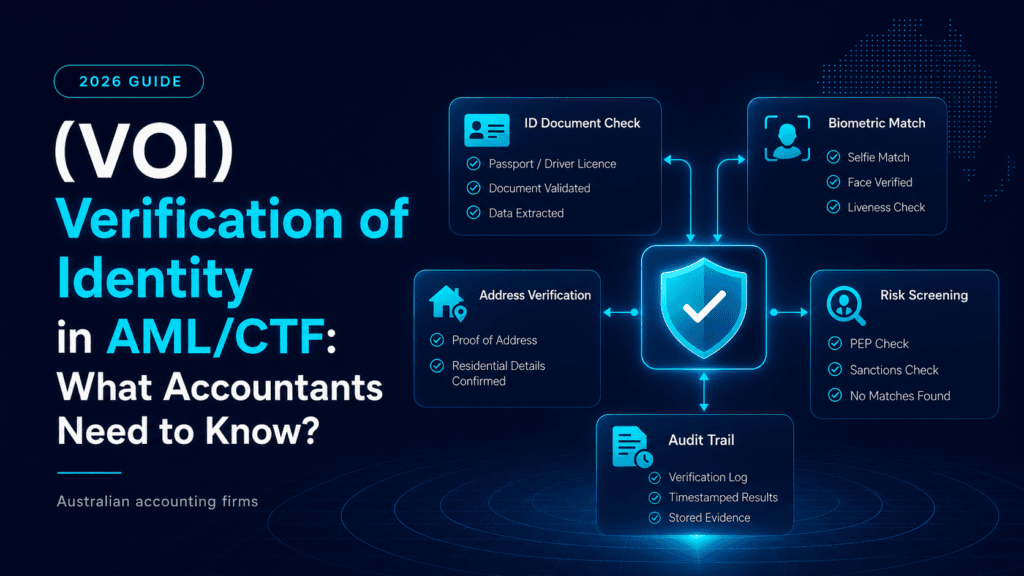
Verification of Identity in AML/CTF is the process of confirming a client’s identity using reliable and independent sources. It typically follows a “100-point” style framework, drawing on government-issued documents such as passports, driver licences, and Medicare cards, cross-checked against the individual presenting them.
Electronic vs Manual VOI
Manual VOI
The traditional approach involves a staff member physically, or via video, inspecting the client’s identity documents, recording the details, and retaining copies. Manual VOI can work, but it is often slow, inconsistent between staff members, and difficult to audit at scale.
Electronic VOI
Modern electronic verification checks identity documents against authoritative databases in real time. It helps confirm whether a document is genuine, current, and matched to the individual presenting it. For accounting firms, VOI becomes faster, more consistent, and easier to document when supported by electronic tools.
This is where client verification automation becomes valuable. It reduces manual handling, supports stronger audit trails, and helps firms apply the same standard across every client.
Why VOI Is Harder Than It Looks
Verification of Identity in AML/CTF may sound simple, but in practice it creates several operational challenges for accounting firms:
- Document fraud is more sophisticated than ever. Fake and altered documents are becoming harder to identify with manual checks alone.
- Consistency is difficult. Different staff members may apply different standards, especially without a clear workflow or centralised system.
- Remote onboarding adds complexity. Many firms now work with clients online, so identity checks must be secure, reliable, and easy to complete without face-to-face meetings.
- Audit requirements matter. Every verification must be documented properly and retained for future review.
That is why AML/CTF compliance software and AI automation for accounting firms are becoming important parts of modern compliance operations.
The 7-Year Record-Keeping Rule
Under AUSTRAC requirements, VOI records — like all customer due diligence records — must be kept for a minimum of seven years. That means every identity verification your firm performs creates a documentation obligation that continues long after the client engagement ends.
Manual systems can make this difficult. Files may be stored across email, folders, spreadsheets, or disconnected systems. With accounting automation, firms can reduce the burden of storing, organising, and retrieving client verification records.
For firms managing high client volumes, VOI is not just a compliance step. It becomes an ongoing workflow that must be repeatable, traceable, and audit-ready.
“A VOI process is only as good as its weakest link — and in most firms, that weak link is inconsistent manual handling and incomplete record keeping.”
How VERA Automates VOI
🤖 Meet VERA — Client Verification Automation
VERA, the Client Verification Automator from NeX Automate, helps automate the VOI process for accounting firms. It supports electronic identity verification, applies a consistent standard to every client, and helps retain complete, time-stamped records for the required retention period.
For your clients, this means a faster, smoother onboarding experience:
- No unnecessary document chasing
- No avoidable delays
- No inconsistent manual handling
For your firm, it means more consistent, defensible, and audit-ready Verification of Identity across every client.
VERA is part of NeX Automate’s broader suite of automation solutions for accounting firms, including accounting automation for firms, ATO Automation, ATO document automation, ASIC Review Automation, and workpaper automation. Together, these tools help firms reduce repetitive admin, improve accuracy, and keep compliance workflows moving.
VERA runs at $25 per hour — you pay only for the verification work it performs.
🤖 Automate VOI at Scale with VERA
Sign up and get 50 free credits to see VERA run live identity checks — electronic VOI, consistent standards, and audit-ready records from the first client.
Start Free – Get 50 Credits →Why Firms That Aren’t Ready Yet Should Act Now
With the 1 July 2026 deadline behind us, AML/CTF compliance is no longer a future project — it’s a current obligation with every new client you onboard. Firms that haven’t fully implemented their processes are now operating with real exposure, and building policies, training staff, creating workflows, and documenting client verification all at once under pressure is exactly the scramble the deadline was meant to avoid.
The good news: verification of identity is the fastest place to close the gap. By standardising VOI now, firms can build a smoother onboarding process and reduce ongoing compliance pressure. The right systems help your team verify clients, retain records, and manage obligations with far less manual work.
Already past the deadline and not fully set up? You’re not alone — but every unverified client onboarded from here carries risk. Prioritising a consistent, documented VOI workflow is the single most effective first step to getting compliant quickly.
AML/CTF compliance for accounting firms goes beyond registration. It creates an ongoing operational responsibility that continues with every new client. That’s why AI automation for accounting firms is becoming essential — it helps reduce repetitive admin, improve accuracy, and keep compliance workflows consistent.
Get Your AML Policies & Staff Training Sorted in 15 Minutes
Behind on the essentials? Complete this quick intake form and we’ll prepare a draft AML/CTF policy tailored to your firm — including your firm’s details, services, responsible persons, and client onboarding workflow.
Book My AML Readiness Assessment →Key Takeaways
- Verification of Identity in AML/CTF confirms a client’s identity using reliable and independent sources.
- Electronic VOI is faster, more consistent, and more auditable than manual checks.
- VOI records must be retained for a minimum of seven years.
- With the reforms now in force, firms not yet compliant should treat VOI as the first priority.
- VERA supports client verification automation and helps firms manage VOI more consistently.
See How NeX Automate Automates Client Verification
Watch VERA run electronic VOI, apply consistent standards, and produce audit-ready records — in a quick, no-pressure demo.
Book a Free Demo →Sources & further reading
- AUSTRAC — Customer identification and verification
- AUSTRAC — Record-keeping obligations
- AUSTRAC — Tranche 2 entities and the 2026 reforms
- Financial Action Task Force (FATF) — The FATF Recommendations (international standards)
Related guides: What AML/CTF means for accounting firms, Customer Due Diligence explained, and the best AML/CTF compliance software for accounting firms.